Action Plan and Roles of Network Members

Action Plan and Roles of Network Members
SANKEN Team started collaboration researches from FY 2013 aiming at Flexible
Sensing Devices with overseas core team. Profs.Yagi, Washio and Numao started
their collaboration researches also in the first FY 2013 on Information Science and
Technology for Sensor-Data Analysis contacting with the overseas collaboration partners
at Drexel University, University of Joseph-Fourier, University of Washington,
TELECOM ParisTech and KU Leuven.
*SANKEN Team:
Research members:
1) Kazuhiko Matsumoto, 2) Katsuaki Suganuma, 3) Junichi Takeya,
4) Kazuhiko Nakatani, 5) Hiroaki Sasai, 6) Takeharu Nagai,
7) Yasushi Yagi, 8) Takashi Washio, 9) Masayuki Numao,
10) Yoshio Aso* and 11) Tsuyoshi Sekitani*. (*: joined in FY 2015)
CtC Office members:
1) Mototsugu Ogura, 2) Yoshihiko Hirotsu, 3)Satoko Tsuchiya (FY 2013),
4) Satoko Nakaseko (FY 2014) and 5) Ayumi Enomoto (FY 2015~ ).
*Overseas Core Team:
1) imec (Jo De Boeck)
2) Purdue University (David Janes)
3) Norwegian University of Science and Technology (NTNU) (Zhiliang Zhang)
4) Max Planck Institute at Mainz (Paul Blom)
5) University of Oxford (Sonia Contera)
6) University of Paris-Sud (Giang Vo-Thanh)
*Overseas collaboration partners:
1) Drexel U. (Ko Nishino)
2) U. Joseph Fourier, U. Rennes 1 (Alexandre Termier: moved from UJF to UR1 in 2015)
3) University of Washington (Jeffrey Bilmes)
4) TELECOM ParisTech (Catherine Pelachaud)
5) KU Leuven (Luc De Raedt)
9 Collaboration Groups:
We organized the following 9 collaboration research groups: R1~R6 in 2013 and
R1~R9 in 2014:
R1 Development Study on Flexible Organic Semiconductors Devices:
J. Takeya (now Univ. Tokyo), Y. Aso* (SANKEN), P. Blom (Max Planck Inst. Mainz)
R2 Development of Advanced Sensing and Wearable Devices and Their Packaging
Technologies:
K. Suganuma(SANKEN), T. Sekitani* (SANKEN), J. De Boeck (imec)
R3 Bio-Sensing using Nanowire:
K. Matsumoto (SANKEN), D. Janes (Purdue Univ.)
R4 Analysis of Bio-Sensing Phenomena:
K. Matsumoto (SANKEN), K. Nakatani (SANKEN), T. Nagai (SANKEN), S. Contera
(Univ. Oxford)
R5 Mechanical Analysis of Nanomaterials for Printed Electronics:
K. Suganuma (SANKEN), Z. Zhang (NTNU)
R6 Development of Novel Bio-Sensing Devices Based on New Reaction:
H. Sasai (SANKEN), G. Vo-Thanh(Paris-Sud)
R7 Omnipresent Vision System by Heterogeneous Cameras:
Y. Yagi (SANKEN), K.Nishio (Drexel Univ.)
R8 Deta Mining from Big Log Data of Electric Devices:
T. Washio (SANKEN), A. Termier (Univ. Joseph Fourier (now Univ. Rennes1)
R9 Machine Learning and Data Mining:
M. Numao (SANKEN), L. De Raedt (KU Leuven)
(*: joined in 2015)
Our Goal:
FY1 2013―FT2 2014 goal: We focused on the Fundamental Functional and Reliability
Studies for the Materials to be used in Wearable Sensing Devices at our Goal; Organic,
Printed, Bio-, and Nanocarbon Materials, and also focused on Information Science and
Technology applicable to Human Health and Safety by means of Sensing Devices.
We started functionalizing the above International Collaboration Groups R1~R9 for their
purposes by sending young researchers to the counterpart overseas Core Team and
collaboration partners (for 1~3 months), and accepting researchers from overseas.
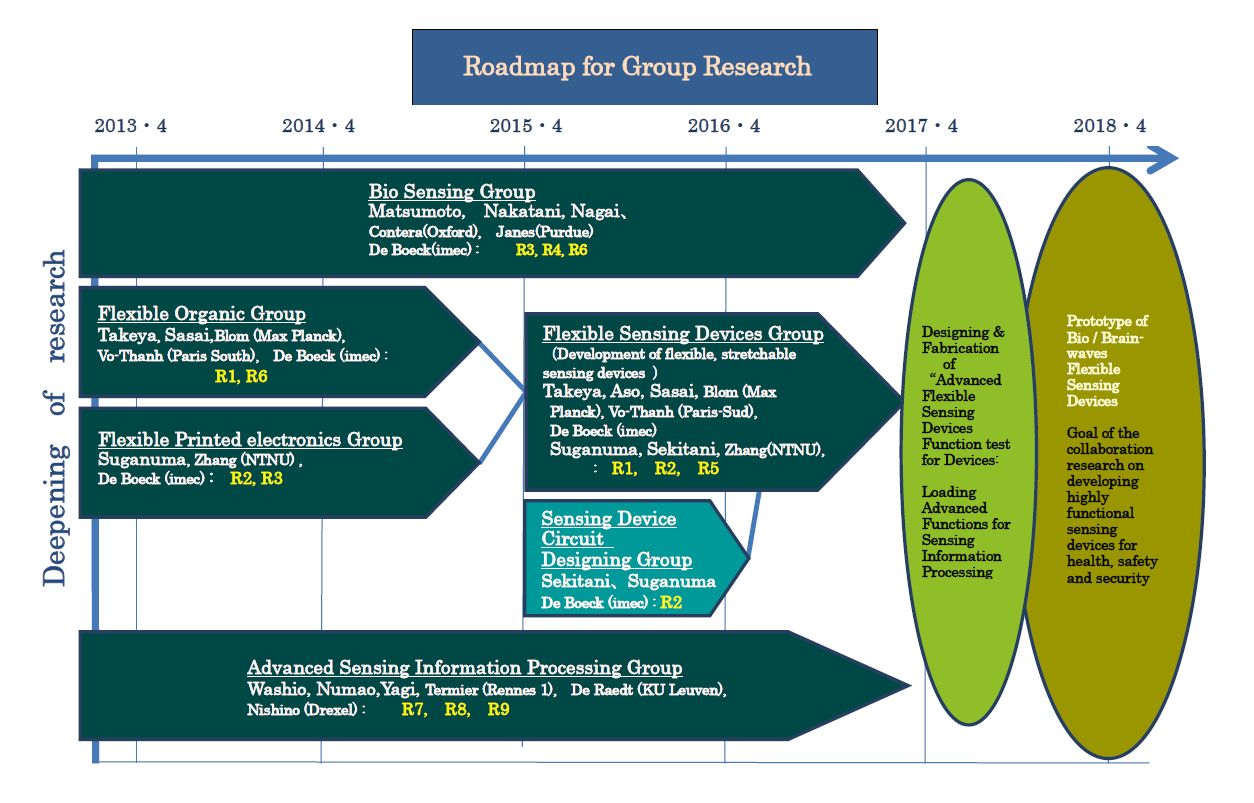
FY3 2015-FY4 2016 goal: From 2015, Y. Aso (Organic device-materials )and T. Sekitani
(Device Design) joined the CtC-program formally for the development of our flexible
sensing devices. In 2015, we decided to concentrate our direction of sensing device study
especially to “ Flexible Bio-Sensing /Brain-Waves-Sensing Devices”. Inter and intra-Group
Collaborations have been much more expected.
FY5 2017 goal: Proto-type Bio/Brain waves flexible sensing devices will be designed and
fabricated, and will be well functionalized by Big-Data Information Technology.
The Road-Map of our CtC Program aiming at “Developing highly functional flexible
sensing devices for health, safety and security” is shown below.